


- Learn two ways to create a Windows Server 2025 bootable USB drive.
- Use Rufus for the quickest setup or Command Prompt for a manual approach.
- The USB drive can be used for clean installations and in-place upgrades.
- The same methods also work for Windows Server 2022, 2019, and 2016.
If you plan to perform a clean install of Windows Server 2025 (or Server 2022), you will need to create a bootable USB drive to start the server and continue the setup. You can complete this task in at least two ways, and this guide will show you how.
Unlike the desktop versions of Windows 11 and 10, Microsoft doesn’t offer a Media Creation tool to download the ISO or create a USB flash drive to install the server version of the operating system. However, it’s possible to create a bootable Windows Server USB drive using commands or third-party apps like Rufus.
This guide will teach you the steps to create a Windows Server USB flash drive.
- Create Windows Server 2025 bootable USB media with Rufus
- Create Windows Server 2025 bootable USB copying files to USB
- Server Decode’s Take
Create Windows Server 2025 bootable USB media with Rufus
To create a Windows Server 2025 bootable USB with Rufus, use these steps:
-
Click the “Download the ISO” link.

-
Use the form to register and download the ISO file.
-
Click the Download now button.
-
Click the “ISO downloads 64-bit edition” option to download the file.

-
Click the link to download the latest version under the “Download” section.
-
Double-click the rufus.3.xx.exe file to launch the tool.
-
Select the USB flash drive to create the bootable media under the “Device” section.
-
Select the “Disk or ISO image” option under the “Boot selection” section.
-
Click the Select button.

-
Select the “Windows Server 2025 ISO” file.
-
Click the Open button.
-
Select the “Standard Windows Installation” option under the “Image option” setting.
-
Select the GPT option under the “Partition scheme” section.
-
Select the UEFI (non-CSM) option under the “Target system” section.
-
Under the “Volume label” section, confirm a name for the USB flash drive. For example, “Server 2025 USB.”
-
Use the default settings for the File system and Cluster size options.
-
Check the Quick format option.
-
Check the “Create extended label and icon files” option.
-
Click the Start button.
-
Clear the “Customize Windows installation” settings.
-
Click the OK button.
-
Click the OK button again.
Once you complete the steps, you can proceed to install the server version of Windows on the device.
Create Windows Server 2025 bootable USB copying files to USB
To create a Windows Server 2025 bootable USB through Command Prompt, use these steps:
-
Open Start.
-
Search for Command Prompt, right-click the top result, and select the Run as Administrator option.
-
Type the following command to open DiskPart and press Enter:
diskpart
-
Type the following command to find out the USB flash drive and press Enter:
list disk
-
Type the following command to select the drive and press Enter:
select disk 2
In the command, replace “2” with the number of the USB removable drive.
-
Type the following commands to erase the flash drive and press Enter:
clean

-
Type the following command to create a primary partition on the drive and press Enter:
create partition primary
-
Type the following command to select the new partition and press Enter:
select partition 1
-
Type the following command to activate the partition and press Enter:
active
-
Type the following command to make the Windows Server 2025 USB flash drive bootable and press Enter:
format FS=FAT32 quick
-
Type the following command to set a drive letter and press Enter:
assign letter=S
In the command, change “S” to any available letter to use.

-
Type the following command to exit the DiskPart tool without closing Command Prompt and press Enter:
exit
-
Type the following command to mount the Windows Server 2025 ISO file and press Enter:
PowerShell Mount-DiskImage -ImagePath "E:\SERVER_EVAL_x64FRE_en-us.iso"

In the command, change the path to the location of the ISO file.
-
(Optional) Type the following command to start DiskPart and press Enter:
diskpart
-
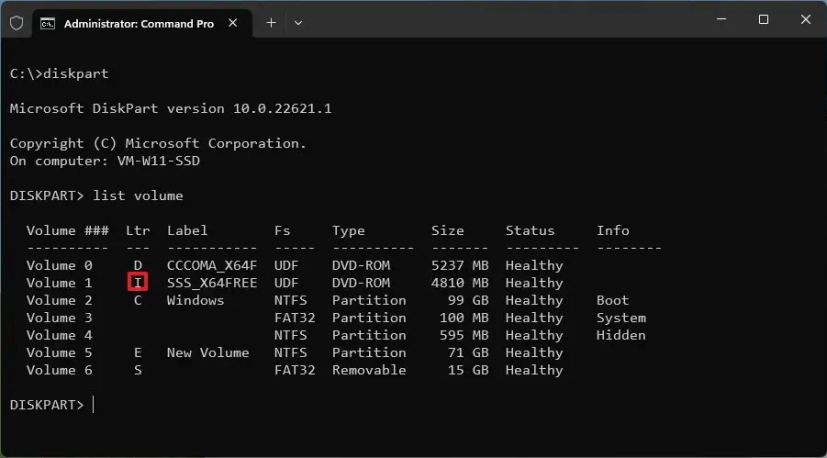
(Optional) Type the following command to find the drive letter for the mounted ISO file and press Enter:
list volume
-
Type the following command to quit the DiskPart tool and press Enter:
exit
-
Type the following command to access the Windows Server 2025 ISO file and press Enter:
I:
In the command, change “I” to the drive letter of the mounted ISO file.
-
Type the following command to enter the “boot” folder in the ISO file and press Enter:
cd boot
-
Type the following command to update the volume boot code on the flash drive and press Enter:
bootsect /nt60 S:
-
Type the following command to copy all the Windows Server 2025 files from the ISO to the USB flash drive and press Enter:
xcopy G:\*.* S:\ /E /F /H
In the command, change the “G” and “S” drive letters to the correct drive letters for the Windows Server 2025 ISO image and the USB drive, respectively.
After you complete the steps, you can use the USB flash drive to perform an in-place upgrade or clean installation of Windows Server 2025.
These introductions should also work to create a USB bootable drive for previous versions of Windows Server, including 2022, 2019, and 2016.
Server Decode’s Take
I almost always recommend using Rufus when creating bootable Windows Server media because it’s the fastest and least error-prone option for most people. The manual method is still valuable, though. If you’re managing servers regularly, knowing how to build installation media with built-in tools can save you when you’re working on a system without third-party utilities or internet access.
One thing I’ve noticed over the years is that Microsoft has never given Windows Server the same installation experience as the desktop version of Windows. There’s still no Media Creation Tool, which means administrators have to rely on the ISO and their preferred method to prepare installation media. It’s not a major problem, but it’s another reminder that Windows Server expects a more hands-on approach.
If you’re creating a USB drive once or twice, stick with Rufus. If you’re learning Windows Server or working in enterprise environments, it’s worth understanding the command-line method as well. It’s one of those skills that doesn’t come up every day, but when you need it, you’ll be glad you know it.
What are your thoughts on creating Windows Server installation media? Do you prefer Rufus or the manual approach? Let me know in the comments.